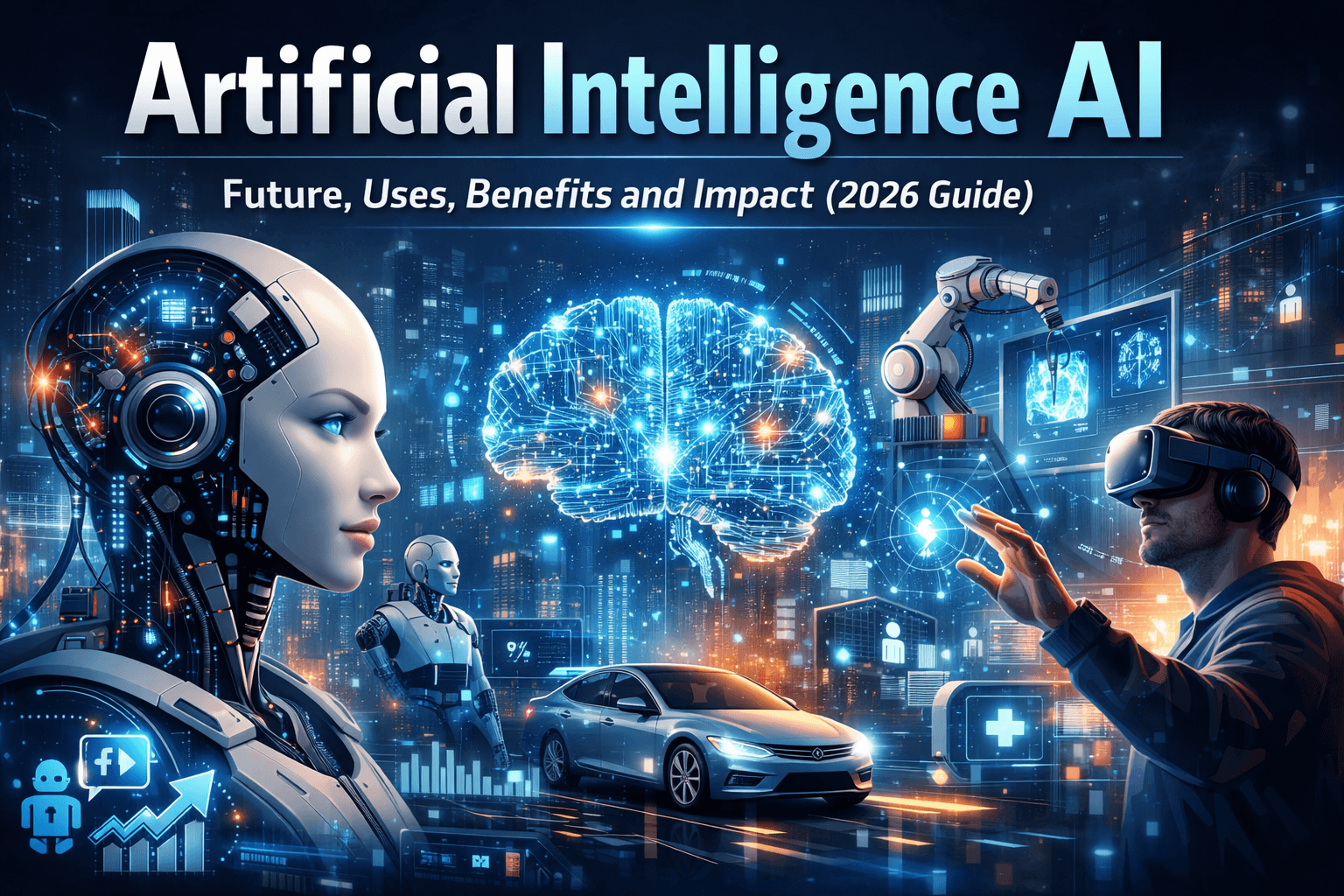
Unlike traditional software, Artificial Intelligence systems can learn from data, recognize patterns, and improve performance over time. Consequently, AI technology is transforming industries faster than many experts predicted only a few years ago.
In recent years, Artificial Intelligence has expanded beyond research laboratories and large technology companies. Smartphones, search engines, online shopping platforms, and streaming services now use AI algorithms daily.
Moreover, social media platforms depend heavily on AI systems to recommend content and improve user experiences. As a result, billions of people interact with Artificial Intelligence without even realizing it.
The growing importance of AI has also increased discussions about jobs, education, ethics, and future technology. Some experts believe Artificial Intelligence will create enormous opportunities for innovation and productivity.
However, others worry about automation, privacy risks, and the future impact on employment. Nevertheless, understanding Artificial Intelligence has become essential for students, professionals, and businesses preparing for the digital future.

What is Artificial Intelligence AI?
Artificial Intelligence refers to the ability of machines and computer systems to perform tasks that normally require human intelligence. These tasks include learning, reasoning, problem-solving, language understanding, and decision-making.
Instead of following fixed instructions only, AI systems analyze information and improve their responses through experience and data processing.
Artificial Intelligence is a major branch of computer science focused on building smart systems capable of simulating human thinking. Furthermore, modern AI technologies combine machine learning, deep learning, neural networks, and natural language processing to solve complex problems efficiently.
Consequently, AI systems can now recognize speech, understand images, answer questions, and even create written content automatically.
Different industries use Artificial Intelligence in unique ways depending on business needs and technical requirements.
Healthcare companies use AI for disease detection and medical analysis. Similarly, financial institutions rely on AI systems for fraud detection and risk assessment.
In addition, online businesses use AI-powered recommendation systems to improve customer engagement and sales performance. Therefore, Artificial Intelligence continues becoming more valuable across nearly every major industry worldwide.
Types of Artificial Intelligence AI
Artificial Intelligence can be divided into several categories based on capability and functionality. Understanding these types helps people recognize how AI systems operate in different environments and industries. Moreover, each type of AI has different levels of complexity and intelligence.
Narrow Artificial Intelligence AI
Narrow AI, also called Weak AI, is the most common type used today. It focuses on performing specific tasks efficiently without possessing general human intelligence. Examples include voice assistants, chatbots, recommendation systems, and facial recognition software. Although Narrow AI performs specialized tasks extremely well, it cannot think or reason outside its programmed purpose.
General Artificial Intelligence AI
General AI refers to machines capable of performing any intellectual task that humans can perform. Unlike Narrow AI, General AI could potentially understand, learn, and adapt across multiple subjects independently. However, this technology still remains under development and has not yet been achieved fully by researchers.
Super AI
Super AI represents a theoretical future stage where machines become more intelligent than humans in every field. This concept includes advanced reasoning, creativity, emotional intelligence, and independent decision-making abilities. Consequently, Super AI raises important ethical and philosophical concerns regarding human control and technological safety.
How Artificial Intelligence Works
Artificial Intelligence works through a combination of data, algorithms, and computing power. AI systems learn patterns from information and use those patterns to make predictions or decisions. Although the technology may seem extremely complex, the basic working process follows several important steps.
Data Collection
AI systems first collect large amounts of information from different sources such as databases, sensors, websites, and user interactions. The quality and quantity of data significantly affect AI performance. Therefore, accurate and diverse data usually produce better results.
Data Processing
After collection, the data must be cleaned and organized before analysis. AI systems remove errors, duplicates, and unnecessary information to improve learning accuracy. Consequently, structured data helps algorithms recognize meaningful patterns more effectively.
Model Training
Machine learning models analyze processed data to identify relationships and trends. During training, algorithms repeatedly adjust calculations to improve prediction accuracy. Moreover, advanced neural networks allow AI systems to process highly complex information such as images and language.
Decision-Making and Learning
Once training is complete, AI systems make decisions based on learned patterns. Furthermore, many AI systems continue improving automatically through continuous learning from new data and feedback. As a result, Artificial Intelligence becomes more accurate and efficient over time.
Key Technologies Behind Artificial Intelligence
Several advanced technologies support the development and functionality of Artificial Intelligence systems. Each technology contributes differently to AI capabilities and real-world applications.
Machine Learning
Machine Learning allows AI systems to learn from data without explicit programming. Instead of following fixed rules only, algorithms improve performance through repeated analysis and experience. Consequently, machine learning powers recommendation systems, fraud detection, and predictive analytics.
Deep Learning
Deep Learning uses layered neural networks to process highly complex data. This technology enables AI systems to recognize speech, understand images, and generate human-like responses. Moreover, deep learning has significantly improved language translation and computer vision technologies.
Natural Language Processing
Natural Language Processing, commonly called NLP, helps machines understand and communicate using human language. AI chatbots, translation tools, and voice assistants rely heavily on NLP systems. Therefore, communication between humans and machines has become more natural and efficient.
Computer Vision
Computer Vision enables AI systems to analyze and interpret visual information such as images and videos. Healthcare, security, and autonomous vehicle industries frequently use computer vision for detection and recognition tasks. As a result, machines can now identify objects and patterns with remarkable accuracy.
Uses of Artificial Intelligence AI in Daily Life
Artificial Intelligence has become deeply integrated into modern daily life. Many people use AI-powered services regularly without fully realizing the technology behind them. Furthermore, AI applications continue expanding rapidly across different industries and personal activities.
Smartphones and Virtual Assistants
Smartphones use Artificial Intelligence for voice recognition, facial detection, photography enhancement, and predictive typing. Virtual assistants like Siri, Alexa, and Google Assistant also rely on AI systems to answer questions and perform commands efficiently.
Healthcare and Medical Services
AI helps doctors diagnose diseases, analyze medical images, and recommend treatment plans more accurately. Additionally, AI-powered robots assist during surgeries and patient monitoring. Consequently, healthcare systems can improve efficiency and reduce medical errors significantly.
Education and Learning
Educational platforms now use AI to personalize learning experiences for students. AI systems analyze learning patterns and provide customized lessons based on student performance. As a result, learners receive more effective and adaptive educational support.
Business and Marketing
Businesses use AI for customer service, targeted advertising, market analysis, and automation. Furthermore, AI chatbots help companies provide customer support continuously without human limitations. Therefore, businesses improve efficiency and customer satisfaction simultaneously.
Transportation and Navigation
Artificial Intelligence supports self-driving cars, navigation systems, and traffic management solutions. AI systems analyze traffic conditions and recommend efficient routes in real time. Consequently, transportation becomes safer and more efficient.
Benefits of Artificial Intelligence AI
Artificial Intelligence offers numerous benefits that improve productivity, innovation, and decision-making across various industries. As AI technology continues evolving, organizations increasingly depend on smart systems to solve complex challenges efficiently.
High Speed and Efficiency
AI systems process large amounts of data much faster than humans. Consequently, businesses can analyze information quickly and improve operational performance significantly.
Improved Accuracy
Artificial Intelligence reduces human errors in tasks requiring precision and consistency. Healthcare, banking, and manufacturing industries especially benefit from AI-powered accuracy improvements.
Automation of Repetitive Tasks
AI automates repetitive and time-consuming work, allowing employees to focus on creative and strategic responsibilities. Therefore, organizations improve productivity while reducing operational costs.
Continuous Availability
Unlike humans, AI systems can operate continuously without fatigue or breaks. As a result, customer support systems and automated services remain available 24 hours daily.

Innovation and Technological Advancement
Artificial Intelligence drives innovation in robotics, healthcare, education, and smart technologies. Moreover, AI research continues creating new opportunities for scientific and industrial development worldwide.
Risks and Challenges of Artificial Intelligence
Despite its many advantages, Artificial Intelligence also creates several important challenges and concerns. Governments, researchers, and businesses continue discussing how to manage these risks responsibly.
Job Displacement
Automation may replace certain jobs involving repetitive manual or administrative tasks. Consequently, workers in some industries may need reskilling and adaptation for future employment opportunities.
Privacy and Security Concerns
AI systems rely heavily on data collection and analysis. However, improper data handling can create privacy risks and cybersecurity concerns for individuals and organizations.
Ethical Issues
Bias, discrimination, and accountability remain major ethical concerns in AI development. If training data contains bias, AI systems may produce unfair or inaccurate decisions. Therefore, ethical AI development has become increasingly important globally.
Lack of Human Emotion and Creativity
Although AI performs analytical tasks effectively, machines still lack genuine emotional understanding and human creativity. As a result, AI cannot fully replace human judgment in emotional or artistic situations.
High Development Costs
Building and maintaining advanced AI systems requires expensive infrastructure, technical expertise, and large computational resources. Consequently, smaller organizations may face financial limitations when adopting AI technology.
Artificial Intelligence AI and the Future Job Market
Artificial Intelligence is reshaping the global economy and employment landscape rapidly. While some jobs may disappear because of automation, many new career opportunities are also emerging.
Technology industries increasingly demand AI engineers, machine learning specialists, data analysts, and cybersecurity professionals. Furthermore, businesses require employees capable of understanding automation systems and digital tools. Consequently, AI-related skills are becoming highly valuable in modern job markets.
At the same time, workers in traditional industries may need additional training to remain competitive. Governments and educational institutions therefore encourage digital skill development and technical education programs. Moreover, lifelong learning has become increasingly important in rapidly changing technological environments.
Artificial Intelligence will likely transform work rather than eliminate human involvement entirely. Humans and AI systems may collaborate together to improve efficiency and productivity across industries. Therefore, adaptability and continuous learning will remain essential for future career success.
Future of Artificial Intelligence AI
The future of Artificial Intelligence appears highly transformative and innovative. Researchers continue developing smarter systems capable of solving increasingly complex problems across industries and societies.
Smart Cities
AI will likely improve transportation systems, energy management, security, and public services in smart cities. Consequently, urban environments could become more efficient and sustainable.

Advanced Healthcare
Artificial Intelligence may enable early disease detection, personalized treatment plans, and improved medical research capabilities. As a result, healthcare systems could become faster and more accurate.
Autonomous Vehicles
Self-driving vehicles and AI-powered transportation systems may become more common in coming years. Furthermore, automation could improve road safety and traffic efficiency significantly.
Artificial Intelligence AI in Education
Future AI systems may provide highly personalized education based on student behavior, learning speed, and performance patterns. Consequently, education could become more accessible and adaptive worldwide.
Human- Artificial Intelligence AI Collaboration
Rather than replacing humans entirely, AI will likely support people in solving complex tasks and improving productivity. Therefore, collaboration between humans and intelligent systems may become standard in many industries.
Conclusion
Artificial Intelligence AI has become one of the most important technologies shaping the modern world. From healthcare and education to business and transportation, AI systems continue transforming industries through automation, data analysis, and smart decision-making. Consequently, Artificial Intelligence now plays a major role in improving efficiency, productivity, and innovation globally.
Although Artificial Intelligence offers enormous benefits, it also creates challenges involving ethics, privacy, and employment changes. Therefore, responsible development and proper regulation remain essential for the future of AI technology. At the same time, students, businesses, and professionals must continue learning new digital skills to adapt successfully to technological advancements.
The future of Artificial Intelligence remains highly promising. As technology continues evolving, AI will likely become even more integrated into daily life, industries, and global economies. Understanding Artificial Intelligence today will therefore help individuals prepare for future opportunities and challenges in an increasingly digital world.